
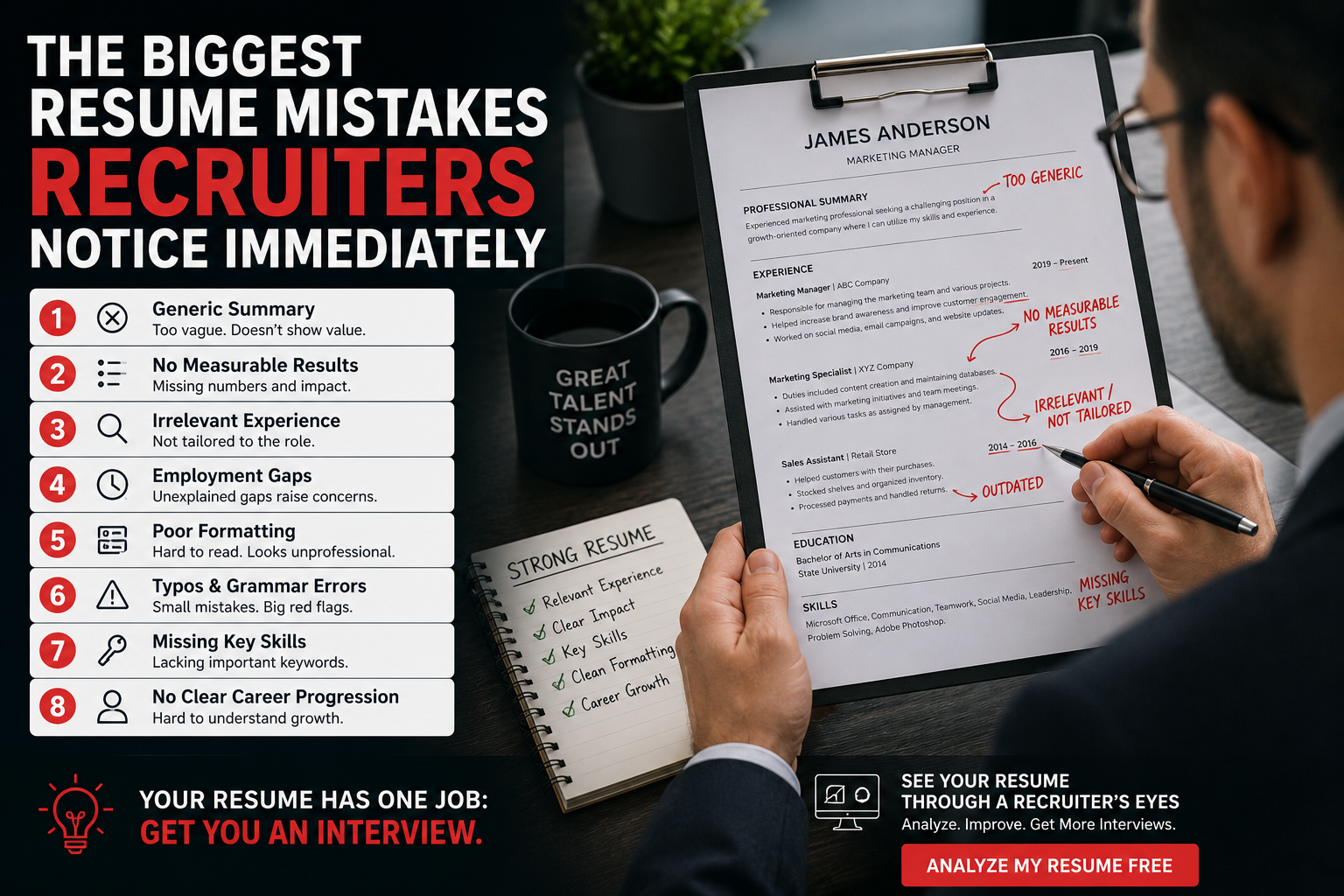
Some weaknesses become visible before the recruiter reads deeply.
In the first article in this series, I explained why qualified candidates never get interviews and how weak positioning can prevent strong applicants from moving forward.
This article goes deeper. It covers the specific mistakes that appear before a recruiter finishes reading—and what to do about each one.
The 10 Biggest Resume Mistakes
Mistake 1: A Generic Professional Summary
Generic summaries waste some of the most valuable space on the page.
Phrases such as these are used too often:
- Results-driven professional
- Team player
- Excellent communication skills
- Highly motivated
- Proven track record
- Strategic thinker
- Detail-oriented
These terms are not automatically wrong.
They become weak when they are not supported by evidence.
Replace generic claims with specifics.
Mistake 2: No Clear Target Role
A resume that tries to appeal to every employer often connects with none of them.
The recruiter should understand your professional direction quickly.
A focused resume is usually stronger than a broad collection of unrelated experience.
Mistake 3: Responsibilities Without Outcomes
A resume filled with phrases such as:
- Responsible for
- Assisted with
- Helped with
- Worked on
- Participated in
can make the candidate sound passive.
Use stronger, more specific language when accurate:
- Led
- Coordinated
- Implemented
- Improved
- Developed
- Managed
- Reduced
- Increased
- Delivered
- Streamlined
Strong verbs help, but the outcome matters more than the verb.
Mistake 4: Important Experience Is Buried
Some candidates place their strongest achievement in the fifth or sixth bullet.
Many recruiters may never reach it.
Place the most relevant and impressive information first.
The top two bullets under each recent position should do most of the selling.
Mistake 5: No Measurable Scope
Numbers provide context.
Useful metrics can include:
- Team size
- Revenue
- Hiring volume
- Customer volume
- Locations
- Projects
- Budget
- Time savings
- Growth
- Retention
- Accuracy
- Productivity
- Compliance
- Quota attainment
Not every bullet needs a number.
But a resume without any scale can feel vague.
Mistake 6: Keyword Stuffing
Some candidates copy large sections of the job description into their resumes.
That may create superficial keyword overlap, but it can damage credibility.
Keywords should be:
- Relevant
- Accurate
- Supported by experience
- Used naturally
- Placed in meaningful context
The goal is not to trick an ATS.
The goal is to communicate qualifications clearly.
Mistake 7: A Difficult-to-Read Format
A visually creative resume may still create problems when:
- Text extraction fails
- Information appears in the wrong order
- Contact details are hidden
- Columns become confusing
- Fonts are too small
- Decorative elements overpower the content
The safest resume designs balance professionalism, clarity, and ATS readability.
Mistake 8: Too Much Unrelated Information
Older or unrelated experience may be useful, but it should not take attention away from the target role.
Prioritize based on relevance.
A recruiter does not need the same level of detail for a job from 15 years ago as for your current position.
Mistake 9: Unsupported Claims
Claims such as:
Top-performing leader
or:
Best-in-class strategist
need evidence.
Credibility comes from specifics.
Show the result instead of praising yourself.
Mistake 10: The Resume Sounds Artificial
AI can improve a resume, but weak AI-generated writing often includes:
- Repetitive sentence structures
- Overuse of buzzwords
- Excessive formality
- Unnatural vocabulary
- Inflated claims
- Generic achievements
- Similar wording in every bullet
A good resume should sound polished, not manufactured.
Recruiter's Tip
See what a recruiter notices before you apply
Career Spy analyzes your resume against the job you want and shows you what may be helping—or hurting—your chances.
How Recruiters Evaluate Your Experience
Experience is not evaluated only by title.
Recruiters look at several layers.
Relevance
How closely does the experience relate to the target role?
Recency
How recently did you perform the relevant work?
Duration
How much time have you spent developing the skill?
Scope
How large or complex was your responsibility?
Results
What did you accomplish?
Progression
Did your responsibilities grow?
Environment
Was the work performed in a similar industry, organization, or operating model?
This is why two candidates with the same job title can appear very different on paper.
One may write:
Managed recruiting.
Another may write:
Led full-cycle recruiting for more than 100 annual placements across 30 healthcare facilities, coordinating sourcing, interviews, credentialing, scheduling, onboarding, and client communication.
The second version gives the recruiter enough context to evaluate the candidate's level.
How Recruiters Evaluate Skills
Not all skill mentions carry the same weight.
Skills Listed Without Evidence
A standalone skills section can help with scanning and keyword discovery.
However, it does not prove proficiency.
Skills Demonstrated in Experience
A skill becomes more credible when it appears in a relevant bullet.
For example:
Built weekly workforce reports using advanced Excel functions and pivot tables to track attendance, staffing gaps, and productivity.
That is stronger than simply listing:
Microsoft Excel
Skills Supported by Results
The strongest evidence connects the skill to an outcome.
Example:
Automated weekly performance reporting in Excel, reducing manual preparation time by approximately four hours per week.
That demonstrates both capability and value.
Recruiter's Tip
Identify missing or underrepresented keywords
Compare your resume with any job description and uncover keyword gaps that may be costing you interviews.
How Recruiters Evaluate Career Progression
Career progression does not always follow a perfect upward line.
People change industries, return to school, accept contract roles, care for family members, start businesses, relocate, and change career direction.
Recruiters understand that careers can be complicated.
What matters is whether the resume tells a coherent story.
A strong resume helps explain:
- Why the candidate is qualified now
- How previous roles built relevant skills
- Why the career transition makes sense
- What value transfers to the new role
- Whether the candidate appears ready for the target level
For a career changer, the resume should emphasize transferable accomplishments rather than unrelated duties.
For a leader, it should emphasize scope, strategy, people, budgets, decisions, and outcomes.
For an early-career candidate, it should emphasize projects, education, internships, technical skills, and potential.
How Applicant Tracking Systems Affect Resume Review
Applicant Tracking Systems help employers organize applications and support recruiting workflows.
They may help recruiters:
- Store resumes
- Search for candidates
- Filter application data
- Review work history
- Search for skills
- Track interview stages
- Compare applicants
- Communicate with candidates
- Manage compliance documentation
An ATS is not necessarily a single robot that makes the final hiring decision.
However, formatting and terminology still matter because recruiters need the resume to be searchable and understandable.
Common ATS-Friendly Practices
Use:
- Standard section headings
- Selectable text
- Consistent dates
- Clear job titles
- Common fonts
- Simple contact formatting
- Recognizable skill terminology
- A logical reading order
Avoid relying on:
- Images for important information
- Icons without text
- Complicated charts
- Skill bars
- Decorative graphics
- Important content in headers or footers
- Text boxes that may extract incorrectly
A polished ATS-friendly resume can still look attractive. It simply uses typography, spacing, alignment, and hierarchy instead of excessive graphic design.
How to Improve the Top Third of Your Resume
The top third is among the most valuable areas on the page because it shapes the first impression.
It should usually include:
- Name
- Contact information
- LinkedIn profile
- Professional headline
- Focused summary
- Core competencies or relevant skills
Example of a Weak Opening
John Smith
Experienced Professional
Hardworking and results-driven individual with strong communication skills seeking a challenging opportunity where I can use my experience and grow professionally.
This could describe almost anyone.
Example of a Stronger Opening
John Smith
Senior Operations and Workforce Management Leader
Operations leader with 12 years of experience managing high-volume workforces, multi-site staffing, employee performance, scheduling, client relationships, and process improvement. Led daily operations for a 250-person workforce supporting a major enterprise account and improved service consistency through structured reporting, accountability, and workforce planning.
The second opening provides:
- Professional identity
- Experience level
- Functional expertise
- Scope
- Evidence
- Direction
That gives the recruiter a reason to continue.
Recruiter's Tip
Strengthen weak resume content
Use the Resume Rewriter to improve your accomplishment statements, remove generic language, and generate an optimized resume.
A Recruiter-Approved Resume Checklist
Before applying, review your resume using these questions.
First Impression
- ☐Is my target role immediately clear?
- ☐Does my headline reflect the position I want?
- ☐Is my summary specific?
- ☐Are my strongest qualifications visible near the top?
- ☐Is the layout easy to scan?
Experience
- ☐Does each recent role begin with the strongest information?
- ☐Do I show accomplishments instead of only responsibilities?
- ☐Have I included useful numbers or scope?
- ☐Is my experience relevant to the target job?
- ☐Are my dates consistent?
Skills
- ☐Are the most important required skills represented?
- ☐Are those skills supported by real experience?
- ☐Have I used both acronyms and full terms where appropriate?
- ☐Did I avoid adding skills I cannot defend?
ATS Compatibility
- ☐Can the text be selected?
- ☐Are section headings standard?
- ☐Is the reading order logical?
- ☐Are contact details easy to extract?
- ☐Are tables or columns disrupting the document?
Writing
- ☐Are the bullets concise?
- ☐Do I repeat the same verbs?
- ☐Did I remove generic filler?
- ☐Is the language natural?
- ☐Is every material claim accurate?
Relevance
- ☐Did I tailor the resume to the position?
- ☐Does the resume address the employer's most important needs?
- ☐Is unrelated information reduced?
- ☐Would a recruiter understand why I am applying?
What I Would Want to See Before Moving a Candidate Forward
After years of reviewing resumes, I did not expect every candidate to be perfect.
I wanted clarity.
I wanted to understand:
- What they had done
- How well they had done it
- Whether it related to the role
- What level of responsibility they handled
- Whether the information appeared credible
- Whether a conversation would be worthwhile
The best resumes made those answers easy to find.
They did not hide strong experience behind generic language.
They did not force the recruiter to guess.
They did not depend on flashy design to create impact.
They communicated value clearly.
That is the real goal.
How Career Spy Helps You Evaluate the First Impression
Most job seekers review their resumes from their own perspective.
That makes sense. You know your career, your responsibilities, your accomplishments, and the context behind every role.
The recruiter does not.
Career Spy is designed to help you examine your resume from the perspective of:
- An Applicant Tracking System
- A recruiter
- A hiring manager
- The specific job you are targeting
Career Spy can help analyze:
- ATS compatibility
- Job-description alignment
- Keyword gaps
- Recruiter readability
- Achievement strength
- Interview preparation
The goal is not to chase a perfect score.
The goal is to create the strongest truthful, natural, and competitive version of your resume before you apply.
See What a Recruiter Notices Before You Apply
You Only Get One First Impression
Career Spy analyzes your resume against the job you want and shows you what may be helping—or hurting—your chances before you click Apply.
Frequently Asked Questions
How long do recruiters spend reading a resume?
There is no single universal amount of time. Recruiters may scan a resume quickly during the first review and spend longer when the candidate appears relevant. The initial decision to continue reading often happens much faster than the detailed evaluation.
What do recruiters look at first on a resume?
Recruiters commonly notice the candidate's recent job title, professional headline, summary, location, layout, relevant experience, and required skills. They are trying to understand the candidate's background and relevance quickly.
What makes a resume stand out to recruiters?
A resume stands out when it is relevant, easy to scan, clearly positioned, supported by measurable accomplishments, and tailored to the target role. Specific evidence is usually more persuasive than generic claims.
Do recruiters read the professional summary?
Many do, especially when the summary helps clarify the candidate's level, specialty, career direction, or transferable experience. A generic summary may be skipped, while a focused summary can improve the first impression.
Should I tailor my resume for every job?
You should adjust the resume for positions that matter to you. Tailoring does not mean rewriting everything. It means emphasizing the most relevant skills, accomplishments, terminology, and experience for the target role.
Do recruiters care about resume design?
Recruiters care about professionalism and readability. Attractive formatting can help, but the design should not make the resume difficult to scan or interfere with ATS parsing.
Is a one-page resume always better?
No. One page may be appropriate for students, recent graduates, and some early-career candidates. Experienced professionals may need two pages to present relevant accomplishments properly. The resume should be long enough to communicate value without unnecessary detail.
Can AI write a good resume?
AI can help improve clarity, relevance, structure, and wording. However, the output should be reviewed for accuracy, tone, unsupported claims, and natural language. AI should strengthen real experience, not invent it.
What should I remove from my resume?
Consider removing outdated objectives, irrelevant early-career details, generic soft-skill lists, references, excessive personal information, unsupported claims, and responsibilities that do not help support the target role.
How can I tell whether my resume will pass ATS screening?
No tool can guarantee passage through every ATS because employer configurations and workflows differ. You can improve compatibility by using selectable text, standard headings, clear formatting, consistent dates, relevant terminology, and a logical structure.
Final Thoughts
Your resume may contain excellent experience and still underperform.
That does not always mean you need more qualifications.
It may mean the value of your experience is not immediately visible.
Recruiters work quickly because they have to.
Your job is to make their decision easier.
A strong resume should quickly communicate:
- Who you are
- What you do
- What you have accomplished
- Why your experience is relevant
- Why the recruiter should keep reading
You do not need to sound perfect.
You need to sound clear, credible, relevant, and worth speaking with.
Before submitting your next application, look at your resume as though you know nothing about the person who wrote it.
Can you understand the candidate within seconds?
Can you identify their strongest qualifications?
Can you see evidence of success?
Can you connect their background to the job?
When those answers are clear, the resume becomes much more powerful.